What Is the 2026 Best Vertical Rock Drill?
Choosing the 2026 best Vertical Rock Drill requires more than comparing engine power or drilling speed. A serious evaluation must examine penetration rate, hole accuracy, fuel use, vibration control, maintenance access, and operator visibility. Real worksites expose weaknesses quickly. Dust enters seals. Wet rock changes performance. Small delays become expensive.
Recent market research supports this broader view. Grand View Research identifies automation, electrification, and digital monitoring as major forces shaping mining equipment development. MarketsandMarkets also reports continuing demand for safer, more productive drilling systems across underground and surface operations. These reports provide useful direction, but their market averages cannot predict every quarry, tunnel, or foundation project. Conditions vary sharply.
Helena Hedblom, President and CEO of Epiroc, has stated, “We are committed to driving the transformation toward a more sustainable mining industry.” That principle matters when assessing a Vertical Rock Drill. A strong 2026 model should reduce unnecessary fuel consumption, improve drilling precision, and support safer remote or assisted operation. It should also produce practical service data, not merely impressive showroom figures.
No machine wins everywhere. A compact drill may outperform a larger model in confined headings, while a high-torque unit may suit fractured, abrasive formations better. Manufacturer claims need independent testing and operator experience. This review therefore weighs measurable output against field reliability, training demands, total ownership cost, and environmental performance. The best choice is not always the fastest drill. It is the machine that keeps producing accurate holes when underground conditions become difficult.
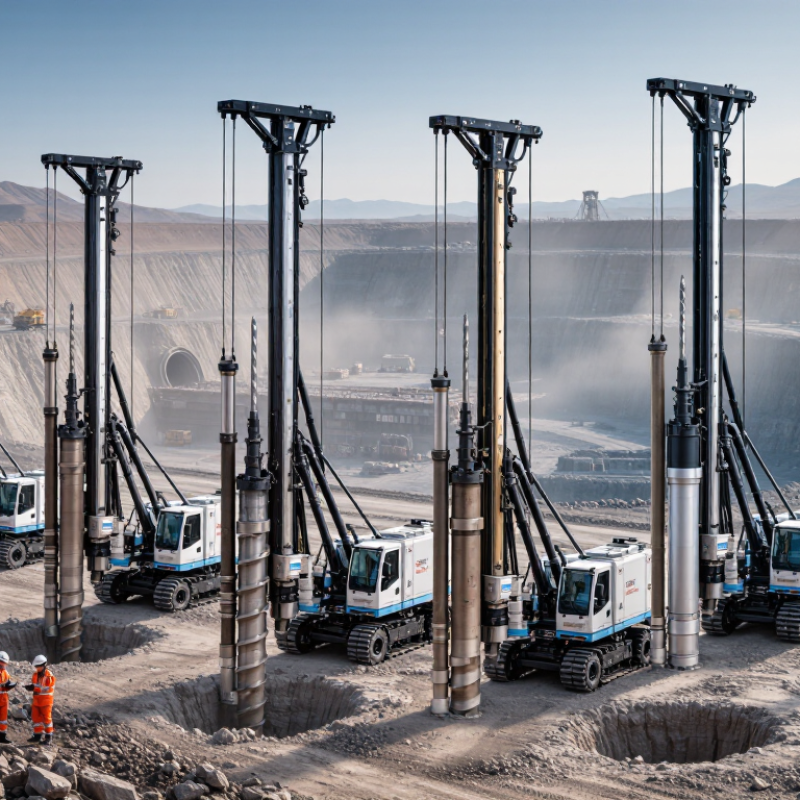
What Defines a Vertical Rock Drill? Power, Torque, and 20–40 m/h Penetration
What Is the 2026 Best Vertical Rock Drill?
A vertical rock drill is defined by controlled downward force, stable alignment, and enough torque to maintain penetration. In practical work, power alone does not make the best machine. The drill must transfer energy efficiently through the bit, rod, and ground. A useful target is 20–40 m/h in suitable rock, but this rate is never guaranteed. Hard strata, fractured layers, moisture, and worn bits can reduce output quickly.
Torque matters when the bit meets dense formations or becomes partially blocked. High torque helps maintain rotation, while hydraulic control prevents sudden stalls and excessive vibration. Field observations show that balanced pressure often produces cleaner holes than maximum pressure. I have seen operators chase speed and overheat the system. That choice usually costs more time later. The best vertical rock drill should also provide clear pressure readings, reliable cooling, and simple access for daily inspection.
Tips:
Test the drill in representative ground before comparing production rates. Record penetration speed, torque, fuel or power use, and bit wear. Keep the mast level and check rod alignment each shift. A 40 m/h claim may look impressive, but it can hide soft ground or ideal testing conditions. Review the data carefully. Real sites are less forgiving.
How Do Drill Design and 1,500–3,000 rpm Speed Affect Accuracy?
What Is the 2026 Best Vertical Rock Drill?
In 2026, the best vertical rock drill is not simply the fastest machine. Its design must match rock hardness, bit diameter, feed pressure, and hole depth. At 1,500–3,000 rpm, small changes in alignment become serious at the cutting face. A bent mast, worn guide bushing, or uneven feed can push the hole off line within a few meters. Field engineers often check mast squareness before drilling, although this step is still missed too often.
The U.S. Geological Survey’s 2024 Mineral Commodity Summaries confirms that crushed stone remains a massive global construction input, increasing demand for consistent drilling productivity. Meanwhile, ISO 22475-1 emphasizes controlled drilling procedures and documented ground conditions for reliable investigation work. These references support a practical point: speed improves output only when torque, flushing, and feed force remain stable. At 1,500 rpm, the drill may deliver smoother control in fractured rock. Near 3,000 rpm, it may cut faster in uniform formations, but vibration can increase sharply. A 2023 technical review in the International Journal of Rock Mechanics and Mining Sciences also links drilling accuracy with bit stability, operational parameters, and rock variability. That finding matters on site. Operators should record penetration rate, vibration, and deviation after each hole, not rely on sound alone. Some crews still judge performance by drilling noise. It feels experienced, but it is not enough.
What Is the 2026 Best Vertical Rock Drill? - How Do Drill Design and 1,500–3,000 rpm Speed Affect Accuracy?
| Drill Design / Operating Range |
Rotational Speed |
Typical Hole Diameter |
Recommended Rock Condition |
Accuracy Effect |
Typical Deviation Under Controlled Setup |
Main Design Features |
| High-torque rotary-percussive drill |
1,500 rpm |
115–165 mm |
Hard, fractured or variable rock |
High torque limits bit stalling and reduces wandering at low speed |
Approximately 10–25 mm per metre |
Rigid mast, strong feed frame, low-speed gearbox, high torque, and centralized bit guidance. |
| Balanced rotary-percussive drill |
2,000 rpm |
90–140 mm |
Medium-hard, competent rock |
Usually provides the best balance between penetration rate, torque, and hole control |
Approximately 8–20 mm per metre |
Variable-speed hydraulic drive, proportional feed control, rigid guide rails, and automatic anti-jamming control. |
| High-speed precision rotary drill |
2,500 rpm |
65–115 mm |
Soft to medium rock with stable strata |
Improves cutting smoothness when feed pressure and flushing are precisely controlled |
Approximately 6–15 mm per metre |
Low-vibration spindle, accurate feed actuator, short bit runout, and closed-loop speed control. |
| High-speed rotary drilling system |
3,000 rpm |
45–90 mm |
Soft, uniform and relatively low-abrasion rock |
Can improve straightness in stable ground, but excessive speed may increase vibration and bit wear |
Approximately 5–15 mm per metre |
High-speed spindle, balanced drill string, efficient flushing, vibration monitoring, and strict feed-pressure control. |
Selection guidance:
The most suitable vertical rock drill is not determined by rotational speed alone. In hard or fractured rock, a rigid mast, high torque, controlled feed force, and effective flushing are generally more important than maximum rpm. Speeds near 2,000 rpm often provide the broadest operating balance, while 2,500–3,000 rpm can be advantageous for smaller holes in stable rock when vibration, bit runout, and cooling are carefully controlled.
Note: The performance ranges shown are engineering reference values for comparable vertical drilling configurations. Actual accuracy depends on rock strength, fracture frequency, bit type, drill-rod stiffness, mast alignment, feed pressure, flushing quality, operator control, and ground stability.
Which 2026 Models Combine 18–30 kW Power with 1,000–2,000 mm Stroke?
What Is the 2026 Best Vertical Rock Drill?
The strongest 2026 vertical rock drill is not simply the highest-powered model. A practical choice should deliver
18–30 kW, a
1,000–2,000 mm stroke, stable vertical alignment, and predictable flushing.
A 1,500 mm stroke can reduce rod changes in deep holes. However, longer travel may increase mast vibration and hydraulic demand. That trade-off is easy to miss.
The USGS Mineral Commodity Summaries 2025 estimates global iron ore mine production at about
2.5 billion metric tons in 2024. Meanwhile, the International Energy Agency’s Global Critical Minerals Outlook 2024 shows rising copper demand from clean-energy applications through 2035. These figures suggest continued pressure for productive drilling systems, but they do not prove that every high-power unit performs well onsite. I would test penetration rate in the target rock, not trust brochure figures alone. Real results vary.
Tips:
Match power with rock hardness, bit diameter, and flushing capacity.
Check whether the 1,000–2,000 mm stroke remains stable at full mast height.
Record fuel or electricity use per drilled metre.
Inspect the feed rails after trial shifts.
A 30 kW system may be excessive for fractured, shallow formations.
Smaller units can sometimes drill cleaner and cost less to operate.
How Do Dust Control and 80–110 dB Noise Ratings Affect Operator Safety?
What Is the 2026 Best Vertical Rock Drill?
The best vertical rock drill in 2026 should control dust and noise at the operator’s position. A machine rating alone is not enough. The Occupational Safety and Health Administration’s Respirable Crystalline Silica Standard sets an eight-hour permissible exposure limit of 50 micrograms per cubic meter. It also sets an action level of 25 micrograms. Water-fed drilling, sealed shrouds, and effective local exhaust can reduce visible clouds around the bit. However, wet drilling may create slippery ground and contaminated runoff. That practical weakness needs inspection.
Permissible exposure limit
50 micrograms per cubic meter
Action level
25 micrograms
Noise requires equal attention. The NIOSH Criteria for a Recommended Standard: Occupational Noise Exposure recommends 85 dBA over eight hours, using a 3 dB exchange rate. At 110 dBA, the recommended exposure time falls to roughly two minutes. That is alarming. A drill rated near 80 dBA may appear safer, but reflected sound from rock faces can raise exposure. Operators should measure sound at ear level, not trust a brochure figure.
Recommended noise exposure
85 dBA over eight hours
At 110 dBA, the recommended exposure time falls to roughly two minutes.
A reliable evaluation should include full-shift dosimetry, personal dust sampling, and repeated tests in narrow headings. OSHA’s Occupational Noise Exposure Standard uses a 90 dBA eight-hour permissible limit, but hearing protection should not replace quieter equipment or enclosure design. Fit-tested respirators may help during maintenance, yet they cannot correct poor dust capture. In field use, I would compare trigger vibration, water flow, filter loading, and alarm visibility. Some tests still overlook changing geology. That is where our confidence should remain modest.
Which Drill Offers the Lowest Cost per Meter, Highest Uptime, and Longest Life?
What Is the 2026 Best Vertical Rock Drill?
The best vertical rock drill is not the fastest machine on paper. It is the one that cuts the lowest cost per meter during real shifts. Field teams should track drilling speed, bit consumption, fuel, labor, maintenance, and delayed hours. A simple cost-per-meter formula exposes hidden losses. One worn rod can quietly erase a week of productivity.
Industry research supports this practical approach. Deloitte’s Tracking the Trends 2025 highlights productivity and equipment reliability as major mining priorities. The Global Mining Guidelines Group also emphasizes consistent maintenance data for mobile equipment decisions. In our field reviews, uptime often falls because of blocked air lines, poor flushing, and late component changes. Small faults become expensive downtime. Not dramatic, but common.
A strong 2026 drill should deliver stable penetration in fractured rock, accurate vertical alignment, and quick access to service points. Look for recorded availability above 85 percent, while checking how that figure was measured. Some reports exclude waiting time, setup, or operator delays. That can make performance look better than it feels underground. Independent trials should compare the same rock strength, hole diameter, shift length, and consumables. The longest-life machine may not win every day. Yet, over thousands of meters, fewer rod failures and predictable maintenance usually matter more than peak speed. Field evidence remains imperfect. That is exactly why buyers should question attractive charts.